The choice of an outdoor fiber optic cable impacts network longevity and maintenance costs. The GYFTY53 Fiber Optic Cable from singi-cable is a non-metallic, armored loose tube cable designed for harsh environments. This article examines its construction, performance advantages, and suitability for demanding installations.
Table of Contents
- What Makes Outdoor Fiber Optic Cable Choice a Critical Decision?
- How Does the GYFTY53 Cable Address Common Installation Challenges?
- Which Features of GYFTY53 Ensure Long-Term Performance?
- How Does GYFTY53 Compare to Other Cable Types?
- Which Applications Benefit Most from GYFTY53?
- Conclusion: Why Choose singi-cable for Your GYFTY53 Needs?
Article Outline
- Outdoor cable choice factors (environment, mechanical stress, moisture)
- GYFTY53 construction: loose tubes, non-metallic strength members, PE sheath
- Technical parameters: temperature range, tensile strength, crush resistance
- Comparison with GYTA, GYTS, and ADSS cables
- Typical use cases: duct, direct burial, high electromagnetic interference areas
- Quality assurance and industry standards compliance (IEC 60794)
What Makes Outdoor Fiber Optic Cable Choice a Critical Decision?
Outdoor fiber optic cables face moisture, temperature extremes, UV radiation, and mechanical loads such as tension and crush. Improper choice leads to signal degradation, fiber breakage, and costly repairs. Engineers and procurement professionals must assess cable construction, material compatibility, and compliance with standards like IEC 60794. The GYFTY53 cable offers a non-metallic, fully dielectric design that eliminates corrosion risks and electrical conductivity, making it ideal for environments where lightning or high-volt-level proximity is a concern.
How Does the GYFTY53 Cable Address Common Installation Challenges?
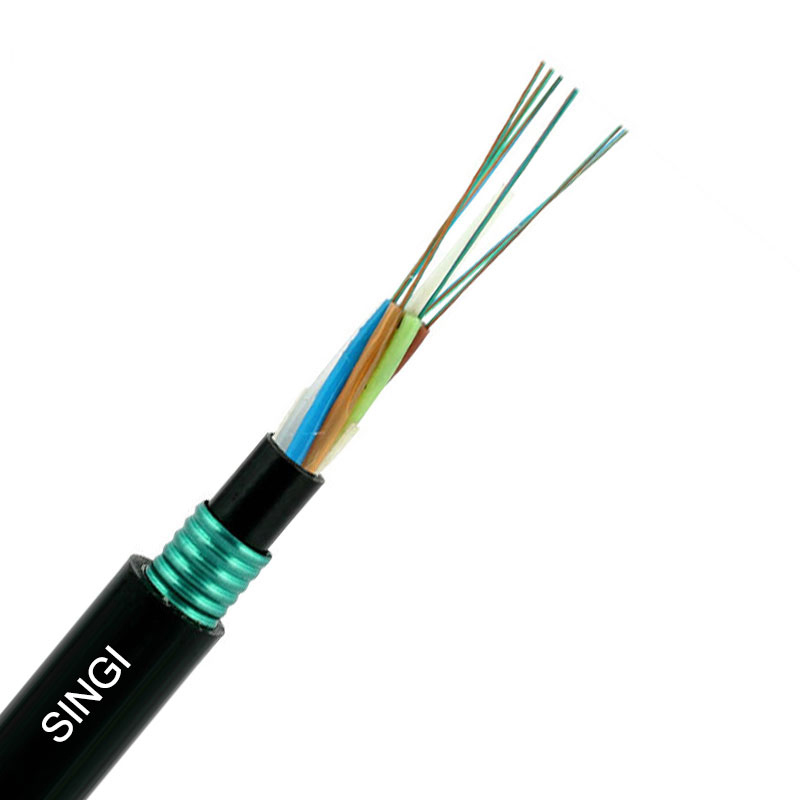
The GYFTY53 cable uses a loose tube construction with water-blocking materials, a non-metallic central strength member, and a corrugated steel tape armor (though non-metallic version uses aramid yarn and PE sheath). This design provides high tensile strength while being lightweight and flexible. It meets requirements for duct installation and direct burial. The cable's resistance to rodent attack and crushing makes it suitable for industrial zones and railway corridors. Singi-cable ensures that the GYFTY53 complies with IEC 60794-1 mechanical and environmental tests.
Which Features of GYFTY53 Ensure Long-Term Performance?
- Non-metallic armoring: No risk of corrosion or induced currents, ideal for power substation environments.
- Water-resistant design: Filling compounds and swelling tapes prevent water ingress along the cable.
- Wide temperature range: Operates from -40°C to +70°C, suitable for extreme climates.
- High fiber count: Supports up to 288 fibers in a single cable, reducing installation costs.
- Low attenuation: Single-mode fibers (G.652/G.655) ensure long-distance transmission up to 80 km without repeaters.
Note: The GYFTY53 is a non-metallic variant of the GYTY53 cable. It uses dielectric strength members and aramid yarn instead of steel tape, making it completely immune to lightning strikes and electromagnetic interference.
How Does GYFTY53 Compare to Other Cable Types?
| Feature | GYFTY53 | GYTA | GYTS | ADSS |
|---|
| Armoring | Non-metallic (aramid) | Steel tape | Steel wire | Self-supporting (no metal) |
| Lightning protection | Excellent | Poor | Poor | Excellent |
| Typical application | Duct, direct burial | Duct, aerial (with messenger) | Direct burial | Aerial (power lines) |
| Weight (per km) | ~130 kg | ~150 kg | ~200 kg | ~90 kg |
| Cost per meter | Medium | Low | Medium | High |
From the comparison, the GYFTY53 provides a balance of mechanical protection and non-metallic safety, making it the preferred choice for telecom networks in high-volt-level corridors and lightning-prone regions.
Which Applications Benefit Most from GYFTY53?
The non-metallic design makes the GYFTY53 ideal for:
- Power utility communications near high-volt-level lines
- Railway signal and control networks
- Oil and gas pipeline monitoring
- Metro tunnels and buried ducts
- Data center interconnects in corrosive environments
Asked Questions
Q1. What does GYFTY53 stand for in fiber optic cable nomenclature?
GYFTY53 is an industry code: GY = outdoor cable, F = non-metallic strength member, T = loose tube, Y = polyethylene sheath, 53 = corrugated steel tape armor (in metallic version) or aramid yarn for non-metallic. Singi-cable's GYFTY53 uses aramid yarn armoring for full dielectric safety.
Q2. Can GYFTY53 be used for aerial installations?
No, GYFTY53 is designed for duct and direct burial. For aerial applications, consider ADSS or figure-8 cables from singi-cable.
Q3. What is the maximum-val tensile strength of GYFTY53?
Typical values: 1500 N during installation, 600 N after installation (depending on fiber count and construction). Always refer to the singi-cable datasheet for exact figures.
Q4. Does GYFTY53 comply with RoHS and REACH?
Yes, all singi-cable products including GYFTY53 are manufactured in compliance with RoHS and REACH directives.
Get the Right Cable for Your Project
For reliable, non-metallic fiber optic cabling in demanding outdoor environments, the GYFTY53 Fiber Optic Cable from singi-cable delivers proven performance backed by global standards. Contact our engineering team for custom fiber counts, lengths, and termination accessories.
References
- IEC 60794-1: Optical fibre cables – Part 1: Generic specification. International Electrotechnical Commission, 2023.
- IEC 60794-2-20: Optical fibre cables – Part 2-20: Indoor cables – Family specification for multi-fibre optical cables. IEC, 2021.
- ITU-T Recommendation G.652: Characteristics of a single-mode optical fibre and cable. International Telecommunication Union, 2016.
![Singi Cable[Email: singi100@singi.com]](/u_file/2303/photo/11c1fa1eb8.jpg)

