How a Regional ISP Cut Fiber Faults 68% with GYTS Armored Cable
A regional fiber network operator serving 96,000 subscribers along a coastal province rebuilt 340 km of outside plant with GYTS fiber optic cable between March and November. The rebuild cut cable-related faults by 68%, shortened average repair time from 6.2 hours to 2.1 hours, and finished 7% under budget. The results came from one decision: replacing unarmored duct cable with a steel-tape armored loose tube design built for wet, rodent-heavy, construction-heavy routes.
What Did the Operator's Network Look Like Before the Upgrade?
The operator runs 1,100 km of fiber across a coastal region with 1,800 mm of annual rainfall, a monsoon season that lasts from June through October, and salt fog within 12 km of the shoreline. Revenue splits across residential FTTH (61%), SME business lines (22%), and industrial park backhaul (17%). The engineering group numbers 210 people, with 38 field technicians on rotation.
Market pressure arrived in two forms. A national carrier launched symmetric 1 Gbps packages in the same towns, and business customers began writing 99.9% availability clauses into contracts with credits attached. Every storm-season outage now carried a price tag.
Why Did Standard Duct Cable Fail in This Region?
The legacy plant used unarmored loose tube cable pulled into existing 40 mm duct. Four failure modes repeated across the network:
- Water ingress. A thin moisture barrier and gel that migrated in vertical runs let water reach the tube bundle. Hydrogen-induced attenuation and fiber embrittlement produced 62 moisture-related faults during the 2023 monsoon alone.
- Rodent damage. Rural sections with 0.6 m duct depth recorded 27 chew-through faults in 14 months. Repair crews replaced 200 m to 400 m of cable each time.
- Crush damage. Utility road work and heavy vehicle loads deformed duct sections. Unarmored cable rated for low crush loads failed at points where the duct ovalized.
- Aerial spans. Roughly 48 km of ADSS on rural poles developed sag and hardware fatigue. Re-tensioning crews visited the same spans twice a year.
The cost showed up in operating numbers. The network ran at 4.1 faults per 100 km per year. Mean time to repair sat at 6.2 hours. Storm months consumed 41% of all truck rolls. Service level credits reached $38,000 in 2023, and emergency crew overtime added $96,000. Residential churn held at 1.8% annually, with storm-related outages cited in 44% of cancellation calls.
Why Choose GYTS Fiber Optic Cable?
Three alternatives were assessed. Patching the existing cable with better splice enclosures dealt with symptoms, not water paths. Extending ADSS on rural routes solved nothing sag and added wind abrasion. Direct-buried double-armored cable offered the durability the operator wanted, but trenching came in at $18 per meter against $6 per meter for pulling through duct that already existed.
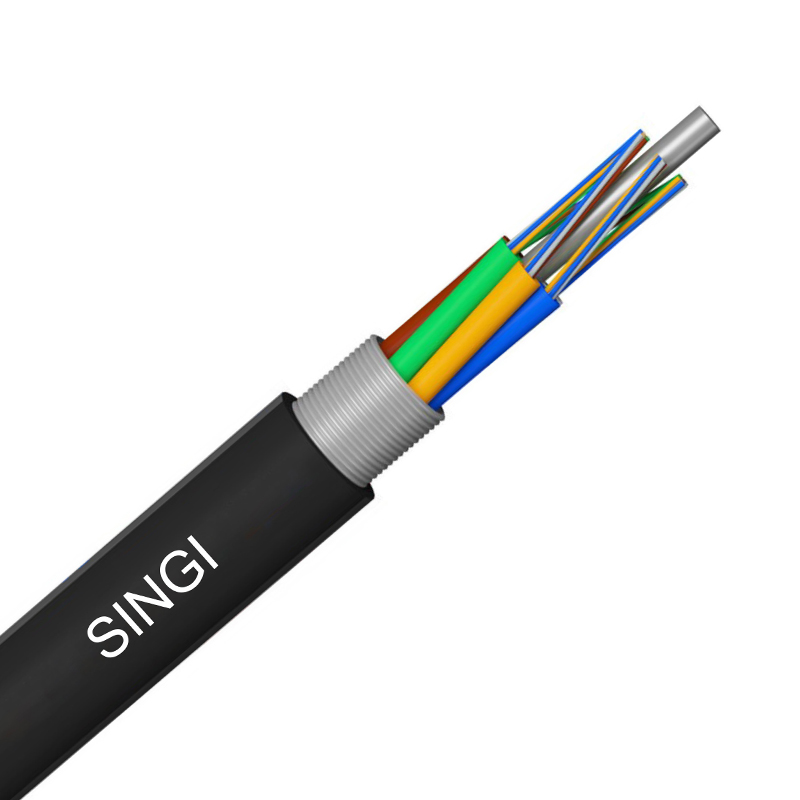
GYTS fiber optic cable from singi-cable matched threat profile:
- Corrugated steel tape armor bonded to a polyethylene jacket blocks rodent attack and resists crush loads of 1,000 N/100 mm long term and 3,000 N/100 mm short term.
- A gel-filled loose tube construction with an aluminum-polyethylene moisture barrier stops water migration along the cable core.
- Short-term tensile rating of 1,500 N and a steel central strength member support long duct pulls without strain on the fibers.
- Bend radius of 20x cable diameter under load and 10x at rest fits existing 40 mm duct, existing aerial hardware, and standard splice closures.
- Delivered cost of $2,150 per km undercut the direct-buried armored option by roughly $330 per km and removed trenching from the scope.
How Was the GYTS Cable Deployed?
The program ran nine months across four phases and covered 340 km of duct and aerial route.
- Duct audit and route survey (6 weeks). Crews rodded and jetted every segment. Thirty-four blocked or collapsed duct runs were cleared or replaced before cable arrived on site.
- Drum acceptance testing. Sampling covered 15% of drums with OTDR traces and fiber geometry checks against IEC 60794-1 test methods. The rejection rate came to 2%, all replaced before installation.
- Controlled pulling. Each pull was logged with a dynamometer capped at 1,200 N, a pulling speed of 10 m per minute, lubricated duct, and one-direction pulls. Average drum length of 2.8 km reduced splice points across the build.
- Splicing and testing. Field teams completed 2,180 fusion splices with an average loss of 0.06 dB, verified by bidirectional OTDR at 1310 nm and 1550 nm.
- Acceptance and handover. Full OTDR records, power meter readings, and as-built route maps were handed to the operations team with splice loss thresholds written into the maintenance standard.
The hardest span ran 6.2 km through an industrial zone with offset duct joints and two 90-degree bends. Pulling tension climbed to 1,600 N at the 4.1 km mark, above the safe limit. The crew split the route into four sub-pulls between access chambers, dropped pulling speed to 8 m per minute, added cable lubricant, and replaced 400 m of duct with a larger bore. The reworked pulls finished with a maximum-val tension of 1,050 N and no fiber damage or added loss.
What Results Did the GYTS Deployment Deliver?
- Cable-related fault rate fell from 4.1 to 1.3 per 100 km per year, a 68% reduction.
- Mean time to repair dropped from 6.2 hours to 2.1 hours.
- Average splice loss improved from 0.11 dB to 0.06 dB.
- Storm-season truck rolls declined 41%.
- Network availability rose from 99.53% to 99.94%.
- Service level credits fell from $38,000 to $4,100 per year.
- Annual operating savings reached $142,000 across repair labor, overtime, and credits.
- Residential churn dropped from 1.8% to 1.1%.
Cable material cost totaled $731,000 for 340 km. The armored construction carried roughly $118,000 in premium over standard duct cable, and measured savings recovered that premium in under 10 months. Business customers on 99.9% contracts renewed without renegotiation for the first time in three years.
What Did the Network Director Say?
“We stopped buying cable on price per kilometer after the 2023 monsoon. The GYTS jacket and steel tape are the reason the last wet season produced four cable faults instead of sixty. My crews now spend their nights on planned splicing work instead of emergency digs, and that change shows up in the retention numbers.”
— Network Operations Director, regional fiber operator
What Can Other Network Builders Take From This Project?
- Match the armor to the actual threat. Rodents and construction traffic justify steel tape armor. A network with clean duct and stable soil can stay with a lighter design and save money.
- Log pulling tension on every span. Tension records caught the industrial zone problem during the pull, not six months later during a fault investigation.
- Order longer drum lengths. Moving from 2 km to 2.8 km drums removed 620 splices from the build, cutting both labor hours and future failure points.
One change would improve the next project. The duct condition survey started after the cable order was placed, and 34 blocked ducts added three weeks of delay. Running the survey first, then ordering against confirmed route readiness, keeps installation crews productive from day one. Specifying water-blocking performance for the tube bundle and the cable core in the purchase document also prevents substitution with a cheaper barrier that fails in year three.
Industry Standards Referenced
- IEC 60794 Series: Optical fibre cables — IEC 60794-1 covers mechanical, environmental, and transmission performance test methods; IEC 60794-3 covers outdoor cables used in duct and aerial applications. (Source: https://webstore.iec.ch/publication/60794)
- Ultra-High Bandwidth Fiber-Optic Data Transmission with a Single Chip Source (44.2 Tb/s) — single-source soliton crystal microcomb transmission at 44.2 Tb/s line rate with 10.4 bits/s/Hz spectral efficiency over 75 km, relevant to long-term capacity planning on armored outside plant. (Source: https://arxiv.org/abs/2106.09472)
![Singi Cable[Email: singi100@singi.com]](/u_file/2303/photo/11c1fa1eb8.jpg)

