A mid-sized packaging machinery manufacturer based in Baden-Württemberg, Germany, builds custom filling and sealing lines for the food and pharmaceutical industries. The company, with 350 employees and an annual output of 120 machines, assembles every system to order, which means every control cabinet is unique. Until a major retrofit project in 2023, the firm relied on a mix of PVC-insulated signal cables sourced from three different regional distributors.
In the years leading up to the project, the OEM noticed a rising number of field failures along the cable pathways inside control cabinets and moving gates. The issues appeared most at termination points where machine vibration worked strands loose. In other cases, the unmarked cable made troubleshooting a guessing game.
Because the company exported roughly 60% of its machines to EU countries, every panel component had to carry proper CE documentation. Several cable lots arrived without valid declarations of conformity, forcing the quality department to quarantine entire wiring kits and wait for the distributor to send revised paperwork. This stalled production lines and created bottlenecks in final assembly.
The internal failure rate reached an average of 3.1 faults per machine during run-off testing. Many faults traced back to cracked insulation from tightly bent wires or to wires pulling out of screw terminals. As a result, the commissioning team lost an estimated 214 hours per year on rework.
Before switching, the engineering team assessed alternative approaches. They tested a halogen-free, tough-sheathed cable but found its larger bend radius impossible to manage in compact swing-arm sections. They also considered a PTFE-insulated solution, but the per-meter price was more than four times the existing material budget.
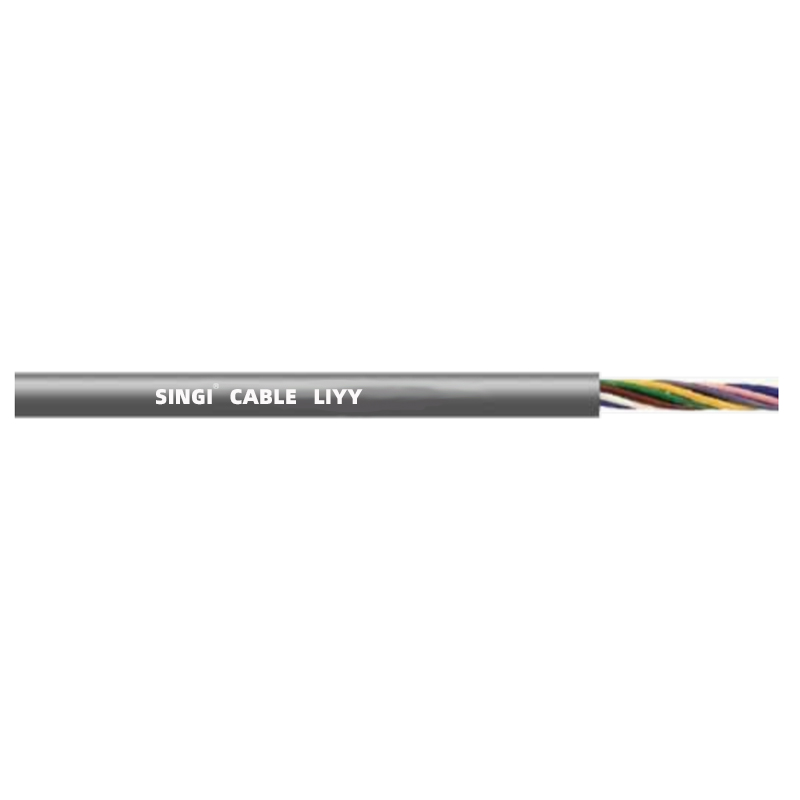
The team shortlisted two suppliers. The other candidate offered a lower price, but its sample cables showed outer-diameter variations of more than 0.3 mm, which caused automatic stripping machines to nick the copper strands. Singi-cable’s LiYY CE Cable, on the other hand, demonstrated consistent dimensions across 30-meter samples and came with a real EN 50525 compliance declaration. The fine-stranded copper conductor also matched the flexibility requirements for moving door harnesses, meeting the company’s internal expectation of 1 million bending cycles.
Singi-cable was chosen not because of its price, but because it could guarantee consistent production quality, provide complete traceability, and ship the entire volume in one shipment from European stock. That eliminated the multi-distributor sourcing headache.
The project began with a five-cabinet pilot run. The OEM’s control panel builders used the LiYY CE Cable to rewire three standard machines and one custom line. During the pilot, the termination team observed that the insulation skin stripped cleanly without sticking to the conductor, leaving no excess PVC debris inside the ferrule crimp area.
Once the pilot received approval from the production manager, the full rollout took place over six weeks. Steps included:
A key challenge surfaced during cold-weather installation: the cable’s flexible PVC became stiffer in unheated workshops. The project lead solved this by moving cable spools into the heated assembly area one day before use, which eliminated cracks in the outer jacket when the wire was bent smaller radii.
Six months after the complete conversion to LiYY CE Cable, the OEM collected data from 50 delivered machines. The results were clear:
The combined effect of these improvements shortened the average machine delivery time from 11 weeks to 9.5 weeks. Two key customers also mentioned the improved appearance of the wiring, which helped the OEM pass stricter customer audits with fewer comments.
“We compared five different flexible control cables, and the LiYY CE cable was the only one that gave us identical strip lengths every time,” said the production manager for cabinet assembly. “It changed how our wire preparation line works.”
“Singi-cable put us on a direct supply schedule. We no longer have to fill orders with two or three different brands from different warehouses,” added the head of procurement. “That alone reduced our administrative overhead.”
This project offers three practical takeaways for other control cabinet builders:
If the OEM started over, they would extend the pilot to include a full series of cold-temperature installation tests. The issue with stiffening was discovered only during routine production and could have been identified earlier by pre-testing cables at a lower ambient temperature.
EN 50525 Series: Electric cables — Low volt-level energy cables of rated volt-levels up to 450/750 V — European standard for PVC-insulated control cables such as LiYY. (Source: https://www.cencenelec.eu)
![Singi Cable[Email: singi100@singi.com]](/u_file/2303/photo/11c1fa1eb8.jpg)

