The CAT 5e 6 6a 7 8 Ethernet Cable range from singi-cable supports modern structured cabling for everything from legacy 100BASE-TX to 25GBASE-T networks. This article explains the engineering differences between each category, clarifies which performance parameters drive choice, and provides a practical framework for choosing the right cable for enterprise, industrial, and data center projects.
This buying guide covers:
| Category | Max Bandwidth | Max Data Rate | Typical Shielding | Common Use Case |
|---|---|---|---|---|
| CAT 5e | 100 MHz | 1 Gbps | UTP or F/UTP | Legacy office networks, basic IP telephony |
| CAT 6 | 250 MHz | 10 Gbps (up to 37–55 m) | UTP or F/UTP | Enterprise LAN, PoE+ applications |
| CAT 6A | 500 MHz | 10 Gbps (full 100 m) | F/UTP or U/FTP | Data centers, 10GBASE-T backbone |
| CAT 7 | 600 MHz | 10 Gbps | S/FTP (shielded pairs + braid) | High-noise industrial environments, 10GBASE-T |
| CAT 8 | 2000 MHz | 25/40 Gbps (up to 30 m) | S/FTP (fully shielded) | Data center top-of-rack and switch-to-server links |
Performance figures above follow common interpretations of ANSI/TIA-568.0-E and the later TIA-568.2-D requirements for balanced twisted-pair cabling.
Ethernet cable categories are defined by frequency limits, insertion loss, crosstalk, and return loss. CAT 5e (Enhanced) improved on original CAT 5 to guarantee 1 Gbps over 100 meters. CAT 6 adds a wider frequency range and tighter crosstalk margins. CAT 6A doubles the bandwidth to 500 MHz and preserves 10 Gbps over the full 100-meter channel.
CAT 7 was designed for severe electromagnetic environments with mandatory fully shielded pairs (S/FTP). CAT 8 is a newer specification that pushes frequency to 2000 MHz while supporting 25 and 40 Gbps over short distances — within racks or between adjacent racks in a data center.
Choosing a lower category than needed will create a bottleneck long before the active equipment is replaced. A CAT 5e link may successfully run 1 Gbps today, but it cannot support 10GBASE-T without significant distance restrictions or installation rework. CAT 6A and CAT 7 support amperage 10 Gbps deployments and provide headroom for higher-speed protocols. CAT 8 is also future-proof for 25GBASE-T and 40GBASE-T, but channel length is limited to 30 meters, so it is not a replacement for horizontal backbone cabling.
For most commercial building projects, ANSI/TIA-568.0-E recommends a minimum-val of CAT 6A for new installations that need to support applications beyond 1 Gbps. The decision affects channel performance, and operating reliability.
Start by listing the expected active equipment and data rates. For a conventional office LAN with gigabit switches and future 10 Gbps upgrades, CAT 6A F/UTP offers a sound balance of cost and performance. In industrial settings with motors, inverters, and other EMI sources, a shielded CAT 7 S/FTP cable reduces bit errors and helps meet EMC compliance.
For data center links inside rows, CAT 8 is the preferred choice when switch-to-server connections require 25 Gbps or higher. Also consider Power over Ethernet (PoE): cable heating increases with current. Larger conductor size (AWG22/23) and higher category ratings, such as CAT 6A and above, dissipate heat with lower DC resistance.
Note: Cable category is only part of the channel. Connectors, patch panels, and installation practices must match the same class. A CAT 6A cable terminated into CAT 5e connectors will not pass a CAT 6A channel test.
When reading supplier datasheets from singi-cable or other manufacturers, focus on these values:
Industry references like ANSI/TIA-568.2-D provide detailed test limits. Matching these limits with an independent test report is the most reliable way to verify a cable's stated category.
Specifying a category based solely on printed label or price is a frequent error. Buyers sometimes assume CAT 7 is better than CAT 6A everywhere, but in a clean office environment, CAT 6A F/UTP is easier to terminate and more economical. Another mistake is ignoring the difference between cable length capacity and actual link length. CAT 8's 30-meter reach is unsuitable for a 90-meter permanent link.
Also, mixing UTP jacks with shielded cable or vice versa breaks the shield path and may fail emission tests., buyers forget to plan for bend radius and pulling tension. A jacket with aramid reinforcement, as used in several singi-cable products, can reduce installation damage.
singi-cable supplies the full range of CAT 5e, CAT 6, CAT 6A, CAT 7, and CAT 8 Ethernet cables with consistent conductor sizes, halogen-free jackets, and clear meter marking. The cables are designed to pass TIA-568.0-E channel requirements and are tested for insertion loss, return loss, and NEXT. For distributors and system integrators, the factory provides flame-test documentation and high-speed data transmission reports.
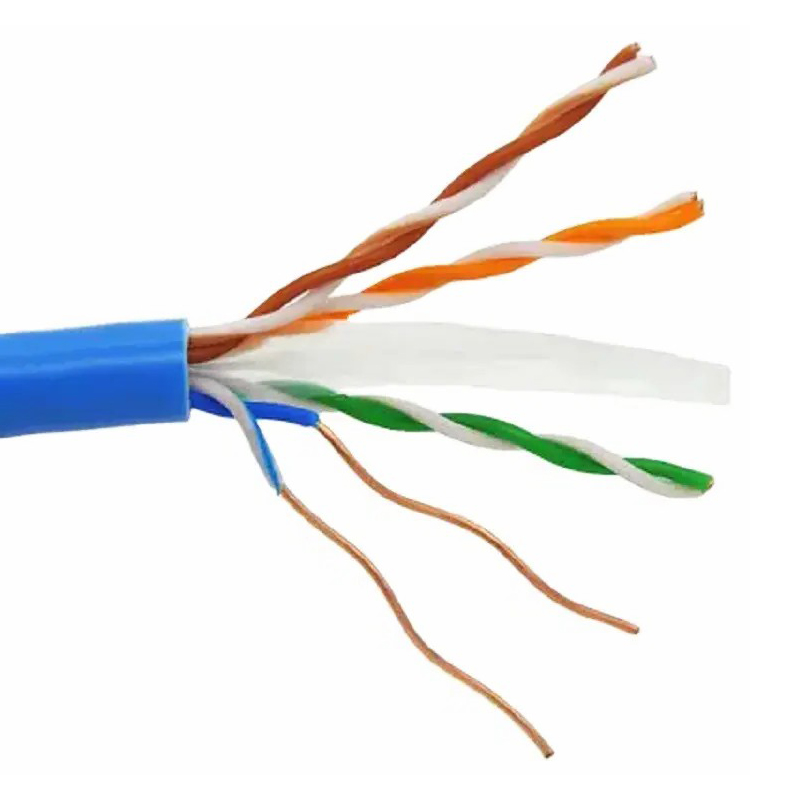
If your project needs a specific outer sheath for outdoor use or low-smoke zero-halogen requirements, contact the sales team and request a CAT 6 / 6E Ethernet cable sample. The same product family also covers CAT5e, 6A, 7, and 8.
Not always. A higher category means more shielding, a larger outer diameter, and a tighter bend radius. Choose the category that matches the channel reach, application rate, and environmental noise.
No. CAT 8 is designed for channels up to 30 meters, for data center end-of-row or top-of-rack cabling. For 100-meter horizontal links, use CAT 6A or CAT 7.
Yes. Fully shielded S/FTP cables require shielded jacks and careful ground continuity at both ends. UTP and F/UTP are simpler to terminate and result in a lower installed cost in low-EMI environments.
Ask the manufacturer for a test report from a qualified tester. TIA-568.2-D specifies channels and permanent link tests for up to 2000 MHz. Compare those results with the vendor datasheet.
Need a reliable Ethernet cable supply partner? Contact singi-cable for technical datasheets, cable samples, and volume pricing. Visit the CAT 6 / 6E Ethernet Cable product page to request a quotation.
References
[1] ANSI/TIA-568.0-E:2020. Generic Telecommunications Cabling for Customer Premises [S]. Telecommunications Industry Association.
[2] TIA-568.2-D. Balanced Twisted-Pair Telecommunications Cabling and Components Standard [S]. Telecommunications Industry Association.
![Singi Cable[Email: singi100@singi.com]](/u_file/2303/photo/11c1fa1eb8.jpg)

