A mid-sized European control panel manufacturer, based in southern Germany, builds custom control cabinets for packaging machinery, CNC machines, and automated assembly lines. The company employs 140 people and produces roughly 3,200 panels per year, with an average panel containing between 180 and 450 individual wire connections. The customer base includes machine builders in Germany, Switzerland, and Austria, many of whom require tight delivery deadlines and full CE documentation.
As order volumes grew and machines became more compact, the wiring teams found themselves working in tighter spaces. Panel layouts were being miniaturized to reduce overall enclosure size, which meant wires had to bend sharply and be routed through crowded wire ducts. At the same time, customers were demanding longer warranty periods on control cabinets, some extending to 36 months. That put extra pressure on the internal wiring components to perform reliably under continuous vibration and temperature cycling.
Before switching to H05V-K CE cable, the company used standard rigid single-core wiring cables with a Class 1 conductor. While those cables were inexpensive, they created three distinct problems.
First, the solid conductors were difficult to route in compact cabinets. Wire teams had to straighten each conductor, measure precisely, and then bend it with pliers to fit the duct paths. This added time to every panel. A typical cabinet took 11 to 14 hours of wiring labor, and 20 percent of that time was spent manipulating the conductors into place.
Second, solid conductors were prone to breakage at terminal connection points. Vibration from nearby contactors and frequency drives caused stress fractures where the wire entered the terminal cage. The company documented a failure rate of 4 percent in final testing, and that did not include failures discovered in the field. Some panels were returned under warranty because control wires snapped internally, leading to intermittent machine stops.
Third, the company was using a mix of cables from several suppliers, each with its own documentation format. When a machine was delivered to a customer, the wiring team had to assemble a CE declaration file that included material certificates, test reports, and declaration of conformity for every cable type. With different suppliers, the paperwork did not always sit neatly together, and chasing missing certificates caused shipping delays of two to three days on roughly twenty percent of projects.
These problems affected cost and reputation. Estimated scrap and rework due to wire breakage cost $38,000 per year. More, late deliveries put pressure on relationships with machine builder customers who operated with -in-time schedules.
The customer assessed three options. One was to continue using rigid single-core cables and accept the breakage rate as normal. The second was to switch to a thin-walled heat-shrink tube over the rigid cable, which added cost but not much flexibility. The third was to replace the wiring entirely with a flexible cable that still met the European standard for internal wiring.
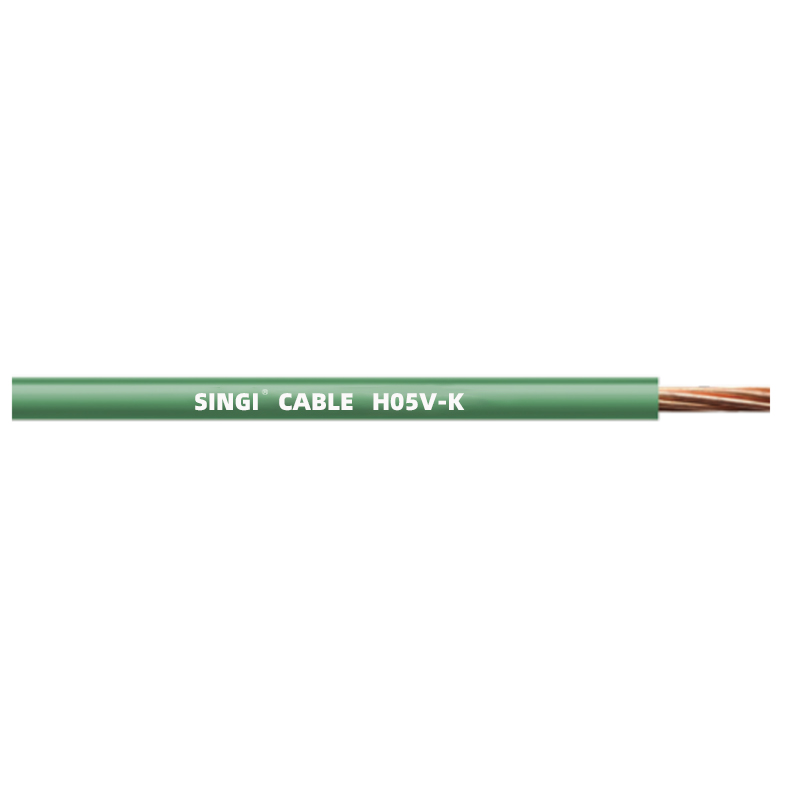
The engineering team reviewed EN 50525-2-11, the standard that defines H05V-K type cables. They found that a Class 5 flexible conductor cable would meet their electrical requirements while offering far better bend performance. The customer ran a two-week trial with H05V-K CE cable supplied by singi-cable. The trial used 1.5 mm² and 2.5 mm² sizes, both with a 500 V rated volt-level and 70 °C rated insulation temperature.
The key decision factors were clear.
The purchasing manager later noted that the decision came down to lifecycle cost. The cable price was slightly higher than standard solid cable, but the reductions in rework and testing time made the overall panel cost lower.
The implementation was phased over four weeks.
In the first week, the engineering team updated the wiring documentation to specify H05V-K CE cable for all control and power circuits up to 2.5 mm². They also notified the panel assembly teams the change and distributed a small set of cable samples for practice.
The second week focused on calibrating strip lengths. Because H05V-K has a stranded conductor, stripping tools needed minor adjustments. The team ran 30 test strip cycles and determined the correct blade depth to avoid nicking individual strands. This step was important because stranded wires are more vulnerable to strand damage if the strip is set too aggressively.
In the third week, the company switched the entire wiring station inventory from rigid cable to H05V-K CE cable. They also updated their ERP system with the new part numbers and re-linked the production planning tool to display the correct cable type for each panel order.
A typical issue arose with ferrule crimping. The team discovered that the fine-stranded H05V-K cable required the correct ferrule length for each terminal size. Early trials with oversized ferrules led to loose crimps. The production supervisor solved this by creating a quick-reference chart that mapped wire cross-section to ferrule type and crimping tool setting. This chart was laminated and placed at every wiring bench.
After the four-week transition, the customer ran a full month of parallel production with the new cable, measuring test failures and wiring times. The results met all internal targets, and the company permanently changed its approved vendor list to include the H05V-K cable as the preferred product.
The customer tracked comparing the six months before and after the switch. Four metrics showed measurable improvement:
Those improvements translated to cost savings. The company estimated that reduced rework, lower scrap, and less documentation labor saved $92,000 in the first twelve months from the change. This amount was more than enough to offset the modest premium paid for flexible cable over rigid cable.
Delivery punctuality also improved. With fewer wiring defects waiting to be reworked, the company reduced its average order lead time from 18 working days to 15 working days. That made a noticeable difference during peak months.
"The switch to H05V-K CE cable was one of the easiest improvements we have made in our production process," said the production manager. "The wiring teams noticed the difference on the very first panel, and our test department saw fewer issues right away. Having one cable type for 90 percent of our internal wiring simplified both procurement and compliance."
He added, "If we had known that documentation alone would become such a bottleneck, we would have standardized earlier on a single flexible CE-rated cable."
Several practical lessons stand out from this application.
First, standardize early. Using fewer cable types reduces inventory complexity, cuts documentation effort, and makes rework easier. In this case, choosing one flexible H05V-K CE cable for all internal wiring removed the headache of matching different supply certificates.
Second, measure the total cost, not the purchase price. The H05V-K cable cost 10 percent more per meter than the old rigid cable. Yet the reduction in testing and rework saved far more than that. When assessing cable options, include the cost of time spent fault-finding, rerouting, and maintaining documentation. Those are the hidden drivers behind the decision.
Third, pay attention to installation details. With stranded cable, the strip tool and ferrule choice matter. The customer's quick-reference chart was a small change that prevented a significant spike in crimping defects during the first week of transition. Any panel builder making this change should run a focused training session on stripping and crimping settings.
, if the project were to be repeated, the customer would consider implementing H05V-K CE cable across its entire range sooner. The team used it parallel to the old rigid cable during a trial phase, which added an extra week of dual inventory. In hindsight, a full switch with a shorter overlap would have been as safe and would have simplified the learning curve.
The following industry standards are relevant to the use of H05V-K CE cables in low-volt-level control panels:
![Singi Cable[Email: singi100@singi.com]](/u_file/2303/photo/11c1fa1eb8.jpg)

