Outdoor fiber optic cables must withstand moisture, temperature swings, and mechanical stress while maintaining signal integrity. The GYTS fiber optic cable from singi-cable meets these demands with a steel-tape armored, loose-tube design. This article explains its construction, benefits, and choice criteria for engineers and procurement professionals.
Indoor cables lack the moisture barrier, strength members, and armor needed for outdoor exposure. Outdoor cables like GYTS must resist water ingress, UV radiation, temperature extremes, and mechanical loads. The GYTS fiber optic cable is designed with a polyethylene outer sheath, water-blocking materials, and a steel tape armor that sets it apart from indoor riser or plenum cables. For long-haul networks, these features are essential to maintain low attenuation over decades of service.
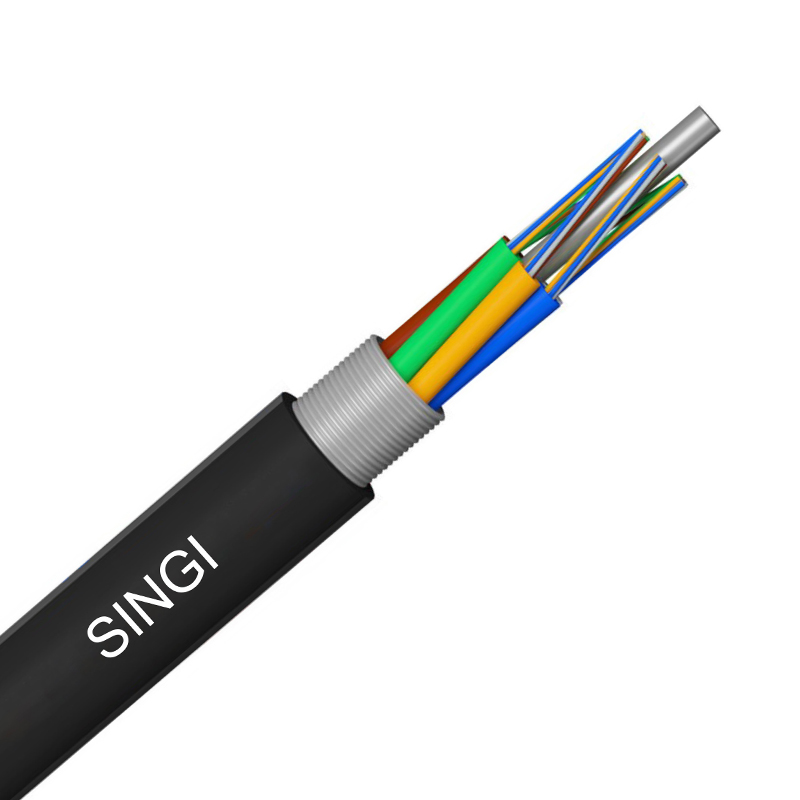
Steel tape armor is a defining characteristic of the GYTS construction. It protects the optical fibers from crushing forces during direct burial, rodent bites, and accidental excavation. In aerial applications, the armor adds mechanical strength to withstand wind and ice loading. A non-armored cable would be more vulnerable to damage, leading to signal loss or complete failure. The corrugated steel tape in GYTS cables also acts as a moisture barrier, enhancing long-term reliability.
Note: For environments with high rodent activity or frequent ground disturbance, armored cables like GYTS are strongly recommended over unarmored types.
A typical GYTS fiber optic cable contains
GYTS fiber optic cable is used in outdoor trunk lines, metropolitan area networks, and long-haul backbone routes. It works in duct, direct-buried, and aerial installations (with appropriate messenger wire). It is not designed for indoor use or tight bends. Typical applications include fiber-to-the-home (FTTH) distribution, campus networks, and inter-building connections.
| Parameter | GYTS | GYTA (non-armored) | GYXTW (central tube) |
|---|---|---|---|
| Armor type | Corrugated steel tape | None (aluminum tape moisture barrier) | None (bilateral steel tape possible) |
| Primary use | Direct burial, duct, aerial (with messenger) | Duct, aerial (light duty) | Duct, aerial (limited fiber count) |
| Crush resistance | High | Medium | Low to medium |
| Water blocking | Gel + tape | Gel + tape | Gel |
| Typical fiber count | 2–96 | 2–144 | 2–12 |
Choose GYTS when installation conditions demand maximum-val mechanical protection. For purely ducted routes with low risk, GYTA may be more cost-effective.
Even the best GYTS fiber optic cable can fail if installed incorrectly. Key guidelines include:
Manufacturing and testing of GYTS fiber optic cable follow international standards. The IEC 60794 series ( IEC 60794-1 for optical fibre cables) specifies mechanical, environmental, and transmission performance., the cable design references Telcordia GR-20 for optical fiber cable in central office environments. These standards ensure consistency and reliability across deployments.
Yes, but it must be lashed to a messenger wire due to the armor weight. Self-supporting all-dielectric cables (ADSS) are lighter for long spans.
GYTS cables support singlemode (G.652, G.655) and multimode (OM1–OM5) fibers. Singlemode is typical for long-haul; multimode for shorter distances.
GYTS has a steel tape armor for higher crush and rodent resistance. GYTA uses an aluminum tape moisture barrier but no armor. GYTS is heavier and more expensive but offers more protection.
No, it is not designed for submerged or submarine use. For wet environments, consider a cable with double steel tape or submarine cable.
For reliable outdoor optical transmission, choose the GYTS fiber optic cable from singi-cable. Our cables meet IEC 60794 standards and are available in custom fiber counts and lengths. Contact us for a quote tailored to your project.
[1] IEC 60794-1. Optical fibre cables – Part 1: Generic specification [S]. 2020.
[2] IEC 60794-3. Optical fibre cables – Part 3: Outdoor cables [S]. 2021.
[3] Ultra-High Bandwidth Fiber-Optic Data Transmission with a Single Chip Source (44.2 Tb/s). ArXiv:2106.09472 [physics.optics]. 2021.
![Singi Cable[Email: singi100@singi.com]](/u_file/2303/photo/11c1fa1eb8.jpg)

