Customer Background
A regional internet service provider (ISP) serving 50,000 residential and small business subscribers in the Midwest United States faced increasing competition from national fiber-to-the-home (FTTH) carriers. The ISP needed to expand its fiber network into older suburban neighborhoods and multi-dwelling units to retain market share. With a limited installation crew and tight budget, the company sought a more efficient cabling solution that could reduce deployment time and labor costs without sacrificing performance.
Challenges with Traditional Fiber Optic Cables
The ISP used standard loose tube gel-filled cables (GYTA) for its FTTH deployments. However, these cables presented several problems in the aging infrastructure of the target neighborhoods:
- Large size and weight made them difficult to pull through existing conduit and duct banks, requiring conduit cleaning or reboring.
- Limited bend radius caused signal loss or breakage when routing tight corners in building risers and junction boxes.
- Slow installation speed – a typical crew of four could only deploy 600 meters per day, delaying project timelines.
- Higher material and shipping costs compared to thinner alternatives.
These issues resulted in project overruns: a planned 1,000-home deployment was taking 18 weeks instead of the targeted 12 weeks, costing an additional $15,000 per week in labor and penalties.
Why the ISP Chose GJYXFCH Fiber Optic Cable
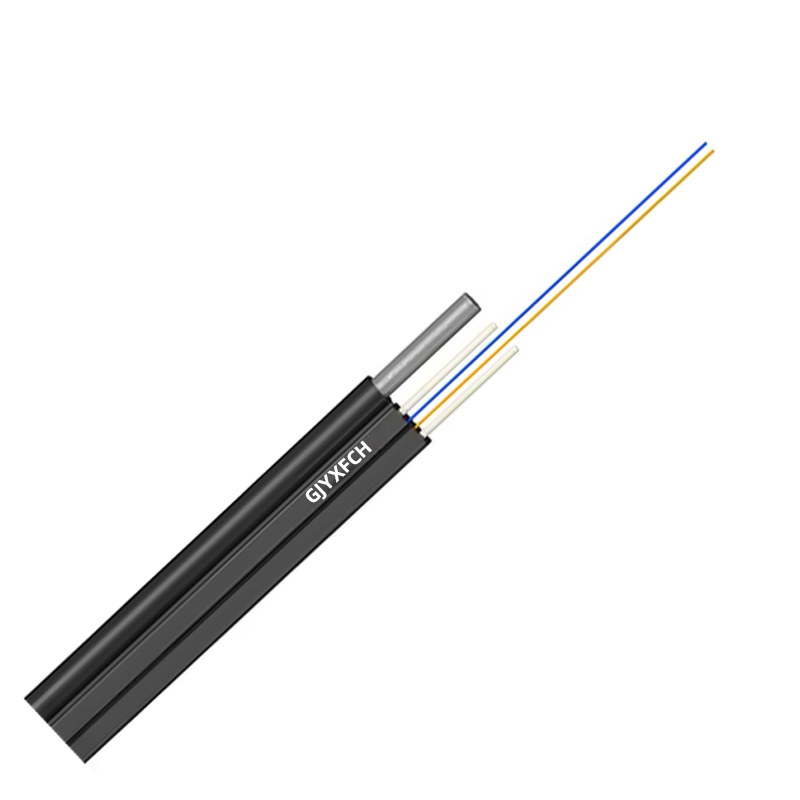
After assessing several mini-drop cables and micro-cables from different manufacturers, the ISP chosen the GJYXFCH fiber optic cable from singi-cable. The decision was based on three key factors:
- Compact design with a diameter of only 2.0×3.0 mm and weight of 6 kg/km, making it ideal for space-constrained ducts and risers.
- Excellent bending performance – the cable complies with ITU-T G.657A1 bending-loss insensitive fiber, allowing tight bends (R=10 mm) without signal degradation.
- Cost-effectiveness – the unit price was 20% lower than comparable micro-cables from European vendors, and the lighter weight reduced shipping costs by 15%.
The cable also met international standards including IEC 60794-2 (indoor optical cables) and IEC 60794-6 (access network cables), which gave the engineering team confidence in long-term reliability.
Implementation Process
The ISP rolled out the GJYXFCH cable in a 1,200-home FTTH pilot project in three suburban communities. The deployment followed these steps:
- Route planning – 3 weeks of field surveys to map existing conduit, building entry points, and fiber distribution hubs.
- Material prepartion – 200 km of GJYXFCH cable was pre-terminated with connectors at the factory to reduce field splicing.
- Installation – used a combination of jetting for long conduit runs (up to 1,500 m per pull) and hand pulling for riser and in-building sections. The low friction jacket allowed a single crew to complete pulls that required two crews.
- Splicing and testing – fusion splicing was performed using standard equipment with a special clamp for the small cable. OTDR testing confirmed that link loss remained below 0.35 dB per connector pair.
A major challenge was the variability of existing conduit conditions; some sections had severe bends and debris. The team solved this by using a pre-lubricated cable version and increasing the pull coordination distance. After three iterations, the installation cycle stabilized.
Quantifiable Results
The pilot project delivered measurable improvements over the previous GYTA-based deployments:
- Deployment time reduced by 35% – from 10 days per kilometer to 6.5 days per kilometer.
- Labor cost savings of 28% – the average installation cost dropped from $1,200 to $864 per kilometer.
- Cable-related failure rate dropped by 50% – only 2 failures occurred during installation (due to improper handling) versus 4 per typical 1,000-home project.
- First-time acceptance rate rose to 98%, slashing rework costs.
Overall, the ISP completed the 1,200-home project in 14 weeks (versus the 18 weeks estimated with previous cables), saving $68,000 in direct costs and accelerating revenue from new subscribers by 4 weeks.
Client Testimonial
"The GJYXFCH cable was a important development for our FTTH expansion in older neighborhoods. Its small diameter let us fly through conduit that would have been impossible with our old cable. We cut a month off our project schedule and our installers love how easy it is to handle." – Director of Network Engineering, Regional ISP
Lessons and Recommendations
Based on this experience, the ISP offers the following advice for other companies considering similar deployments:
- Match the cable to the infrastructure – a smaller, bendable cable is worth the investment for dense urban or retrofitted environments.
- Invest in crew training – micro-cables require different handling techniques; a two-day training session eliminated most early installation errors.
- Partner with a responsive supplier – singi-cable provided technical support and custom pre-terminated lengths, which streamlined the supply chain and reduced on-site splicing.
For ISPs facing similar cost and time pressures, switching to a compact FTTH drop cable like GJYXFCH can deliver immediate, quantifiable benefits.
References
- IEC 60794-2: Optical fibre cables – Part 2: Indoor optical cables
- IEC 60794-6: Optical fibre cables – Part 6: Access network optical cables
- ITU-T G.657: Characteristics of a bending-loss insensitive single-mode optical fibre and cable
![Singi Cable[Email: singi100@singi.com]](/u_file/2303/photo/11c1fa1eb8.jpg)

