A regional data center operator in central Europe manages three facilities serving over 200 enterprise clients. The company's network backbone relies on outdoor fiber optic cables connecting these facilities across distances up to 15 km. The existing cabling infrastructure was installed over a decade ago and consisted of generic loose tube cables not rated for harsh outdoor conditions. With growing demand for high-bandwidth services like cloud computing and video streaming, the operator faced increasing pressure to improve network reliability and throughput.
The operator experienced frequent signal degradation and intermittent outages, during wet weather and temperature swings. The average link loss across the backbone exceeded 0.5 dB per km, forcing the use of costly optical amplifiers and frequent maintenance dispatches. The team struggled with cable water ingress and fiber breakage at splice points. Downtime events averaged 2-3 hours per month, resulting in lost revenue and SLA penalties. The root cause was traced to the old cable's poor moisture barrier and low tensile strength.
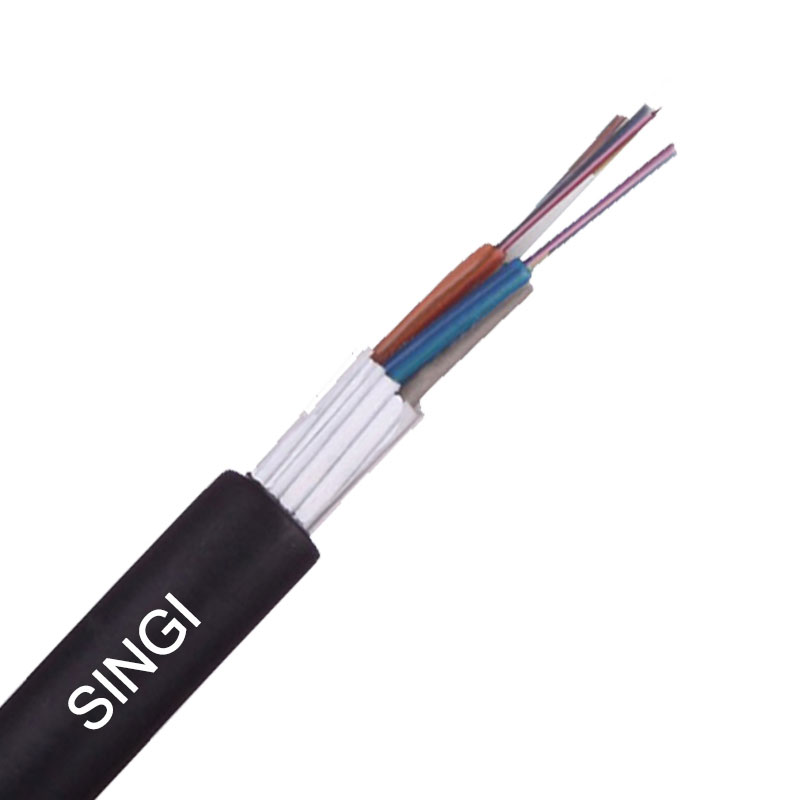
After assessing alternatives from three suppliers, the operator chosen singi-cable's GYFTY fiber optic cable. The decision was driven by the cable's double-jacketed water-blocking design and its compliance with IEC 60794-1-2 standard for mechanical and environmental performance. The GYFTY's central loose tube design offered superior fiber protection against axial stress., the cable's 1310 nm and 1550 nm attenuation rates were guaranteed below 0.35 dB/km, eliminating the need for intermediate amplification. The competitive pricing and 30-year warranty sealed the decision.
The project spanned six weeks across two interconnection routes. The team first performed a detailed route survey and fiber characterization. Then, the old cables were decommissioned section by section to avoid service interruption. The GYFTY cables were installed in existing buried ducts using a pull line and lubricant. Splice closures were re-terminated with GYFTY-compatible trays. A key challenge was retrofitting the gas-blocking connectors to match the new cable's dielectric strength. The singi-cable support team provided on-site guidance to resolve this within two days. Final testing with an OTDR confirmed all links met the required loss budget.
The upgrade produced measurable improvements: average link loss dropped from 0.52 dB/km to 0.31 dB/km, a 40% reduction. Network uptime increased to 99.99% over six months, compared to 99.8% before. Monthly maintenance costs fell by 30% due to fewer truck rolls and no amplifier replacements. The higher bandwidth margin enabled the operator to offer 100 GbE services without additional infrastructure. Project payback occurred in 11 months.
“Switching to GYFTY eliminated our chronic signal issues. The cable's robust construction and consistent performance gave us the confidence to upgrade our core network without rebuilding ducts,” said the operator's infrastructure director.
For organizations planning similar upgrades, three lessons stand out: First, invest in a thorough cable characterization before replacement to set clear baselines. Second, engage the manufacturer early for connector compatibility support. Third, budget for a small buffer of extra cable for future capacity expansion. Repeating the project, we would have run parallel temporary fibers during cutover to reduce user impact further.
1. IEC 60794 Series: Optical fibre cables — Generic specification for mechanical, environmental, and transmission performance. IEC 60794-1 covers general requirements; parts 2, 3, and 6 cover indoor, outdoor, and access network cables respectively. (Source: https://webstore.iec.ch/publication/60794)
2. Ultra-High Bandwidth Fiber-Optic Data Transmission with a Single Chip Source (44.2 Tb/s) — Demonstrates the increasing demand for high-bandwidth fiber infrastructure that drives the need for low-loss fiber cables like GYFTY. (Source: https://arxiv.org/abs/2106.09472)
![Singi Cable[Email: singi100@singi.com]](/u_file/2303/photo/11c1fa1eb8.jpg)

