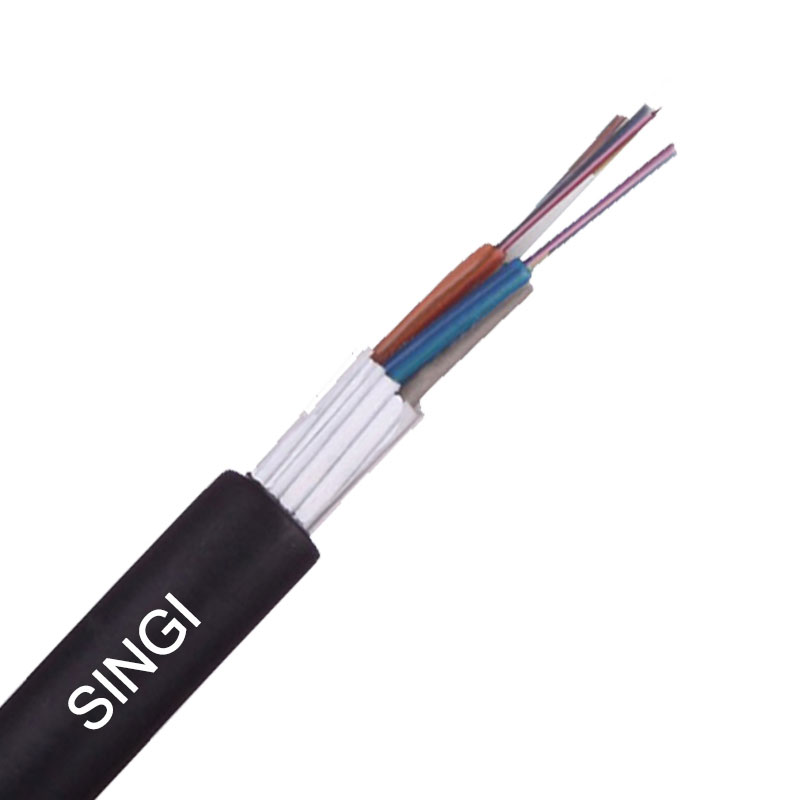
GYFTY is a loose-tube, non-metallic outdoor fiber optic cable. Its full name stands for “GY – Outdoor optical cable, FT – Filling tube (loose tube), Y – PE sheath.” The cable consists of loose tubes filled with water-blocking gel, containing single-mode or multi-mode fibers. A central strength member ( FRP) and aramid yarn provide tensile strength. The outer sheath is black polyethylene (PE), resistant to UV and weathering. GYFTY contains no metal components, making it immune to lightning and electromagnetic interference. It complies with IEC 60794-1-1 generic specifications and IEC 60794-3-10 outdoor cable family standards.
Outdoor optical cables face moisture ingress, temperature extremes, rodent attacks, and mechanical stress. GYFTY addresses these challenges through its design:
These properties make GYFTY suitable for long-haul trunk lines, metropolitan networks, and fiber-to-the-x (FTTx) access networks. singi-cable manufactures GYFTY in various fiber counts (2 to 288 cores) and with G.652.D or G.657.A1 fibers.
Choosing the right cable type depends on environmental conditions and installation method. The table below compares GYFTY with common outdoor cable types from singi-cable.
| Feature | GYFTY | GYTA | GYTS | GYXTW |
|---|---|---|---|---|
| Armoring | None (all-dielectric) | Aluminum tape | Steel tape | Corrugated steel tape |
| Lightning protection | Excellent | Poor (metal attracts lightning) | Poor | Poor |
| Installation | Duct, buried, aerial | Duct, buried | Duct, buried | Direct buried |
| Weight | Light | Medium | Heavy | Medium |
| Cost per meter | Low | Medium | High | Medium |
GYFTY is the preferred choice when electrical isolation is required, such as in power substations, railway lines, and areas with frequent lightning. It also offers the lowest weight, reducing installation labor and support hardware costs.
Choice depends on fiber type, count, and installation environment.
Consult singi-cable for custom configurations tailored to your project specifications.
Yes. GYFTY is suitable for aerial installations when properly lashed to a messenger wire. Its aramid yarn strength members provide adequate tensile strength for spans up to 100 meters depending on wind and ice loading.
The PE jacket alone is not rodent-proof. In areas with high rodent activity, use an armored variant (e.g., GYTS) or install the cable in a protective conduit.
600-1500 N depending on fiber count and construction. Refer to the specific datasheet from singi-cable.
Yes. It is designed per IEC 60794-1-1 and IEC 60794-3-10, and can also comply with Telcordia GR-20 if specified.
Explore the full range of GYFTY fiber optic cable from singi-cable. Our cables are manufactured under strict quality control and tested to meet IEC 60794 standards. Visit the product page for detailed specifications, datasheets, and pricing.
[1] IEC 60794-1-1. Optical fibre cables – Part 1-1: Generic specification – General [S].
[2] IEC 60794-3-10. Optical fibre cables – Part 3-10: Outdoor cables – Family specification for duct, buried and aerial cables [S].
[3] Ultra-High Bandwidth Fiber-Optic Data Transmission with a Single Chip Source (44.2 Tb/s). ArXiv:2106.09472, 2021.
![Singi Cable[Email: singi100@singi.com]](/u_file/2303/photo/11c1fa1eb8.jpg)

