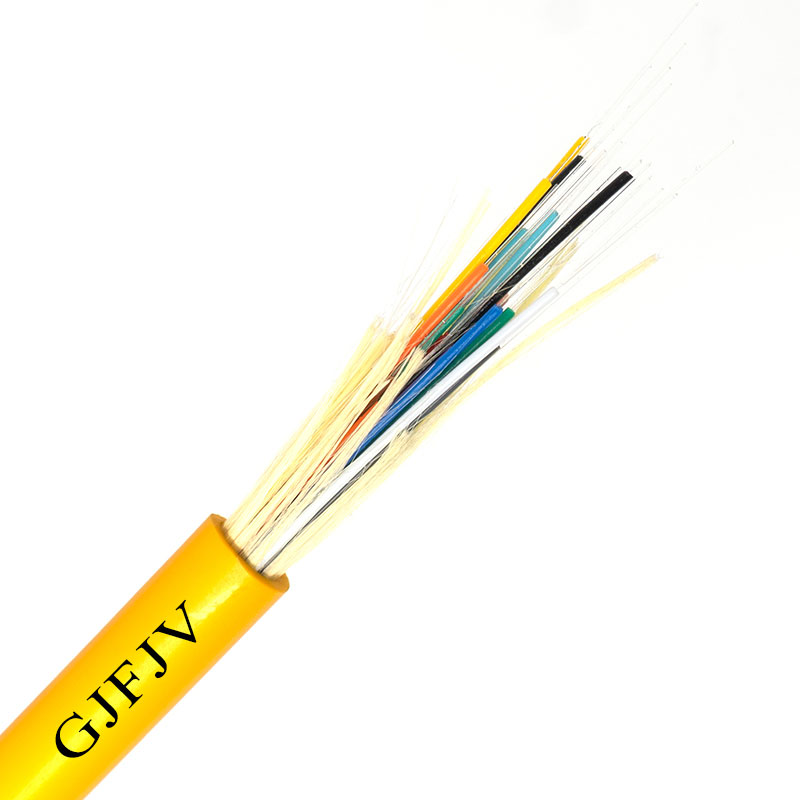
GJFJV fiber optic cable is a indoor tight-buffered drop cable designed for FTTH, LAN, and data center applications. It offers low bend radius, easy termination, and reliable performance under IEC 60794 standards. This article covers its structure, applications, technical parameters, and installation best practices.
GJFJV is a type of indoor optical fiber cable defined by Chinese industry standards (YD/T 1258 series). The acronym stands for: G (optical cable), J (tight buffer), F (non-metallic reinforcement), J (tight sheath), V (PVC jacket). It features a tight-buffered fiber with aramid yarn strength members and a PVC outer sheath. The tight buffer provides direct protection to the fiber, making it ideal for indoor environments where connectors are attached to the fiber. Unlike loose-tube cables, GJFJV eliminates the need for a buffer tube, reducing cable diameter and increasing flexibility. It supports single-mode and multimode fibers, with typical fiber counts of 1, 2, 4, 6, 8, or 12 fibers.
GJFJV cable is deployed in indoor cabling scenarios where space is limited and tight bends are required:
| Parameter | Value |
|---|---|
| Fiber Count | 1–12 fibers |
| Fiber Type | G.652D (single-mode) or OM3/OM4 (multimode) |
| Attenuation (1310 nm) | ≤0.35 dB/km |
| Attenuation (1550 nm) | ≤0.22 dB/km |
| Minimum Bend Radius (static) | 10 × cable diameter |
| Minimum Bend Radius (dynamic) | 20 × cable diameter |
| Operating Temperature | -20°C to +60°C |
| Sheath Material | PVC (LSZH optional) |
| Strength Member | Aramid yarn |
| Standards | IEC 60794-2, YD/T 1258.2 |
Indoor optical cables include GJFJV (tight-buffered, PVC), GJFJH (tight-buffered, LSZH), and GJBFJH (loose-tube, LSZH). The table below highlights differences:
| Feature | GJFJV | GJFJH | GJBFJH |
|---|---|---|---|
| Jacket | PVC | LSZH | LSZH |
| Buffering | Tight | Tight | Loose tube |
| Bend Radius | Low | Low | Medium |
| Smoke Emission | Higher | Low | Low |
| Cost | Lowest | Moderate | Moderate |
| Typical Use | General indoor | Plenum/riser | Vertical/riser |
GJFJV is chosen when cost and ease of termination are priorities, and flame retardancy requirements are standard. For areas requiring zero halogen (e.g., crowded buildings), GJFJH is preferred.
Note: When installing GJFJV cable, avoid exceeding the dynamic bend radius during pulling. Use a tension force below 100 N per fiber (typical). Always strip the tight buffer carefully to prevent micro-bends.
GJFJV is a code: G (optical cable), J (tight buffer), F (non-metallic), J (tight sheath), V (PVC jacket).
No, GJFJV is designed for indoor use only. Outdoor applications require water-blocking materials and UV-resistant jackets (e.g., GYXTW or ADSS).
Yes, tight-buffered fibers allow direct connectorization with LC, SC, or ST connectors using epoxy or prepolished splice-on connectors.
Typical maximum-val pulling tension is 200 N (for 2-fiber cable) to 400 N (for 12-fiber cable), depending on the design.
GJFJV fiber optic cable is a cost-effective and flexible solution for indoor fiber connectivity. Its tight-buffered design simplifies termination and withstands tight bends, making it a popular choice for FTTH and LAN cabling. Singi-cable manufactures GJFJV cables that comply with IEC 60794-2 and YD/T 1258.2 standards, ensuring reliable performance and easy installation.
Looking for a reliable GJFJV cable supplier? Contact Singi-Cable for detailed specifications and competitive pricing.
References:
![Singi Cable[Email: singi100@singi.com]](/u_file/2303/photo/11c1fa1eb8.jpg)

