A regional electric utility in Colombia, serving 350,000 customers across a 120 km transmission corridor, manages a network of 230 kV transmission lines and distribution substations. The utility had been using a copper-based pilot wire system for teleprotection and SCADA communications. The system's age and the region's harsh climate created recurring faults, affecting grid monitoring and operational reliability.
The copper pilot wires were strung along the transmission towers and were damaged by lightning strikes, corrosion, and wildlife. Each disturbance caused a loss of communication between substations, forcing crews to patrol the line to find faults. On average, the utility faced 12 communications outages per month, each taking 45 minutes to isolate and restart. Maintenance crews spent roughly 300 hours per year repairing cable joins and replacing corroded sections. The direct annual maintenance cost had climbed to $85,000, and the utility estimated that unplanned downtime and delayed fault responses contributed to an additional $160,000 in lost operational efficiency, including prolonged outages and manual data collection.
The engineering team considered upgrading the copper system with wireless radios, but line-of-sight requirements and bandwidth limitations made radios unsuitable for future grid automation. They also assessed a standard non-armored GYTA fiber cable designed for duct installation. However, the utility's right-of-way included 38 km of direct burial sections, where soil movement, moisture, and rodents had destroyed previous underground cables. The project team needed a cable that could withstand direct burial without sacrificing fiber performance.
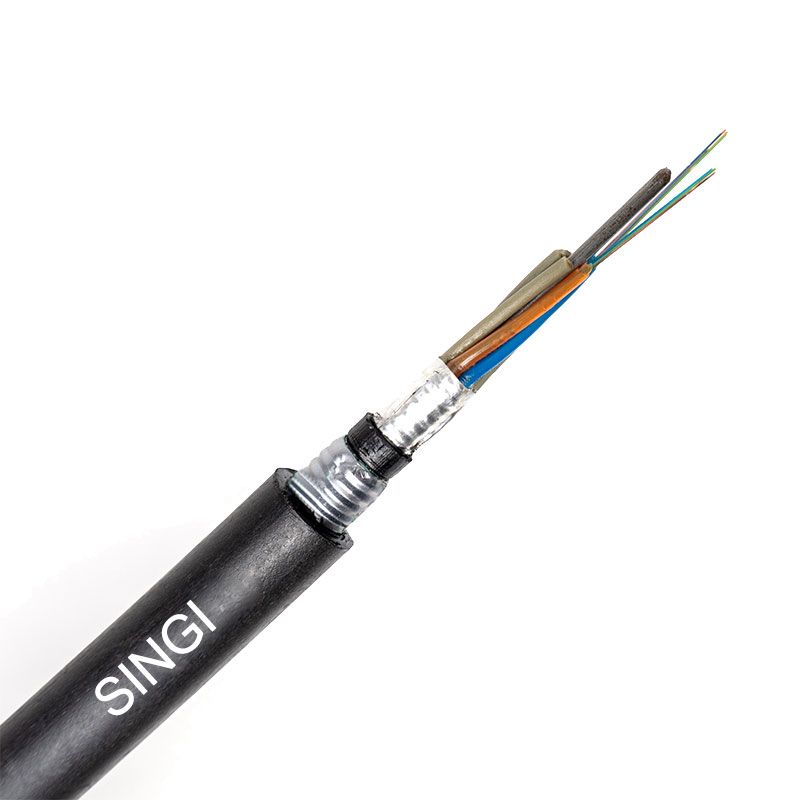
After comparing alternatives, the team chosen the GYTY53 fiber optic cable from singi-cable. The GYTY53 features a steel tape armor layer between the inner sheath and outer PE sheath, providing high crush resistance and protection against gnawing animals and moisture ingress. Unlike the GYTS (steel wire armored) design, which is better suited for duct installation, the GYTY53's steel tape armor forms a continuous moisture barrier, making it ideal for direct burial. The cable also offers good tensile strength, allowing it to handle the pulling forces during installation over uneven terrain.
Another decisive factor was the price. At a delivered cost of $1.35 per meter for the 24-core variant, the GYTY53 was 18% cheaper than comparable armored cables from other brands, while maintaining compliance with IEC 60794-3 outdoor cable requirements. The utility ordered 124 km in a 24-core configuration, leaving 12 spare fibers per span for future expansion and OTDR testing.
The project was planned over six months, and the physical installation took 22 weeks. The route was split into three zones: overhead attachment on transmission towers, conduit installation under road crossings, and direct burial along agricultural land. In the direct-burial zones, crews plowed the cable to a depth of 1.2 meters, adding warning tape and sand bedding. For the 3 km river crossing, the team used horizontal directional drilling, pulling a 40 mm conduit beneath the riverbed, and then blew the GYTY53 cable through using a pulling rope.
One of the typical difficulties involved a 2.5 km stretch through rocky hillside. Initial attempts to use a vibratory plow met hard bedrock, causing the pulling tension to exceed the recommended limit. The team switched to a trench-cutting machine, and the cable was laid in a pre-cut slot with a protective layer of chosen soil. The project manager recorded every pulling point using a tension meter, ensuring the strain never exceeded 1,500 N, well below the cable's allowable rating. Fusion splicing was performed with a mass fusion splicer, and each splice point was housed in a sealed fiber dome closure. After installation, an OTDR trace was taken for every fiber to confirm the cable's end-to-end attenuation of 0.22 dB/km at 1550 nm.
Since the network went live in March 2024, the utility has reported a 75% reduction in communication-related downtime. Monthly outages dropped from an average of 12 to 3, and the average recovery time fell from 45 minutes to 10 minutes. The SCADA system now supports real-time feeder monitoring, and the utility has enabled remote fault-locating tools that were impossible with the copper network. Bandwidth capacity jumped from 100 Mbps to 10 Gbps, allowing the utility to deploy high-definition cameras and sensor networks at five priority substations in the second phase of the project.
Maintenance costs have fallen by $120,000 per year, eliminating the need for copper splice replacements and lightning-damaged repairs. The total project cost, including cable, civil works, and splicing, was $410,000. With annual savings of $180,000 from reduced maintenance and avoided downtime, the project payback period came in at 18 months.
The utility's communications and grid automation manager commented, "The GYTY53 cable performed exactly as specified during installation and in service. The steel tape armor gave us confidence for the direct burial sections that have historically been problem areas. We would choose the same cable again for the next corridor."
For other organizations planning long-haul outdoor fiber networks, three lessons stand out. First, specify an armored cable for any route that includes direct burial; non-armored cables may save a small upfront cost but fail prematurely in rugged soil conditions. Second, calculate total lifecycle cost, not the per-meter price. The team found that the GYTY53's low cost combined with long-term reliability translated into a rapid payback. Third, require post-installation OTDR testing on 100% of fibers. The initial test results flagged two possible splice issues that were corrected before the network was accepted. A fourth reflection is that the team would allocate more time for surveying difficult terrain before ordering cable, because the final length included 8% more cable than planned due to route adjustments.
The GYTY53 fiber optic cable design follows the requirements set by the IEC 60794 series, including IEC 60794-1 for general specifications and IEC 60794-3 for outdoor cables. These standards define mechanical, environmental, and transmission performance requirements for optical fibre cables. Recent research on ultra-high bandwidth fiber-optic transmission, using single-chip sources and advanced modulation formats, demonstrates the growing capacity demands that modern cabling infrastructure must support. Utilities planning multi-decade network assets should choose cables that comply with these standards to ensure compatibility with future high-speed transmission equipment.
![Singi Cable[Email: singi100@singi.com]](/u_file/2303/photo/11c1fa1eb8.jpg)

