A regional telecom provider based in Southeast Asia operates an extensive fixed-line network serving over 200,000 households across dense urban districts and suburban towns. With growing demand for high-speed broadband, the company committed to an aggressive fiber-to-the-home (FTTH) expansion plan, aiming to pass an additional 50,000 homes within a single fiscal year. The company's engineering team had previous experience with conventional drop cables, but the pace of deployment and quality of existing installations were failing to meet the project's cost and timeline targets.
The provider's installation crews faced recurring problems when laying conventional fiber drop cables in apartment corridors, narrow conduits, and outdoor aerial spans. Standard single-mode cables exceeded the allowable bend radius at tight corners, causing signal attenuation and occasional fiber breakage. Indoor installations required a different cable type than outdoor runs, forcing crews to splice at every transition point. This doubled the labor time per home and increased the risk of dust entering connectors.
Cable damage during installation was the largest cost driver. Inspections found that 4% of all drop cables were damaged or failed optical time-domain reflectometer (OTDR) tests after pulling. Revisits, re-terminations, and wasted cable lengths added an average of $12 in labor and material cost per subscriber drop. The engineering team compared alternative designs, including round drop cables with loose-tube construction and armored indoor cables, but none offered a practical combination of bend tolerance, indoor-outdoor compatibility, and low cost.
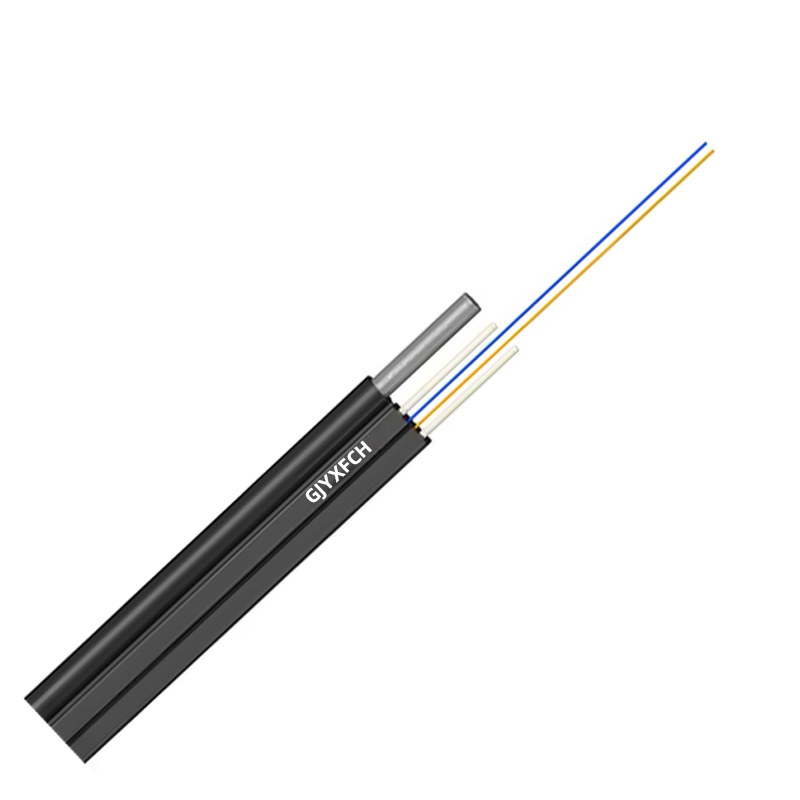
The decision to assess the GJYXFCH fiber optic cable came after the provider's procurement team compared six different supplier products. The GJYXFCH was chosen for three distinct advantages. First, it uses G.657A2 bend-insensitive fiber, which tolerates a bend radius of 7.5 mm—roughly half that of standard G.652D fiber. This allowed installers to route the cable through small corners and narrow cable trays without special protection. Second, the cable's integrated figure-8 profile included two parallel steel reinforcement wires and a central strength member, making it strong enough for outdoor aerial lashing while still flexible enough for indoor routing. This dual-use capability eliminated the need for most indoor-outdoor transition splices. Third, the GJYXFCH was available with a low smoke, zero halogen (LSZH) sheath for indoor sections, simplifying compliance with building safety regulations.
The supplier, singi-cable, provided a 1,000-kilometer pilot batch with consistent diameter tolerances and clear marking, which the provider's engineering team verified against the IEC 60794 series specifications.
Field deployment began in suburban districts where aerial installation was the dominant method. The project spanned three months, with training conducted during the first two weeks. The implementation followed four steps:
The main difficulty encountered was securing the cable in vertical riser shafts where the cable's relative stiffness made it awkward to manage. The team solved this by introducing simple pulleys and pre-lubricated pulling grips, which reduced pulling force and protected the sheath. Re-training was required for crews unfamiliar with the figure-8 cross-section, but standardized bending templates reduced errors after the first week.
After the pilot deployment, the provider measured improvements across three key metrics:
Overall, the FTTH rollout reached 42,000 homes in the first nine months, ahead of the original schedule. The reduction in splice points also lowered the end-to-end attenuation profile, with average optical loss per drop improving by 0.4 dB. Customer installation appointments were completed faster, and the provider's fiber service activation rate increased as fewer technicians were needed for repeat visits.
The provider's network construction manager summarized the project outcome: "The GJYXFCH cable let our teams finish in less time without adding complexity. We no longer worry a tight corner in a corridor, and we have cut our splice inventory in half. It was the most straightforward change we made this year."
Other telecom operators planning FTTH networks can replicate this success by following a few practical guidelines. First, spend time training crews on bend-insensitive cable handling; although the GJYXFCH is forgiving, good pulling techniques still prevent sheath damage. Second, adopt pre-connectorized or pre-terminated drop cable assemblies to reduce field splicing labor—this created the biggest single time saving in this project. Third, run a pilot on 200–500 homes before a full rollout to verify duct compatibility and aerial hardware. In hindsight, the provider would have ordered a few professional pulling grips earlier, since the initial improvisation cost roughly a day of installation time on early sites. The adoption of the GJYXFCH fiber optic cable is supported by the IEC 60794-1 general specification, IEC 60794-3 outdoor cable requirements, and the access network cable standard IEC 60794-6, which together define the mechanical and transmission performance that operators should verify when sourcing drop cables.
![Singi Cable[Email: singi100@singi.com]](/u_file/2303/photo/11c1fa1eb8.jpg)

