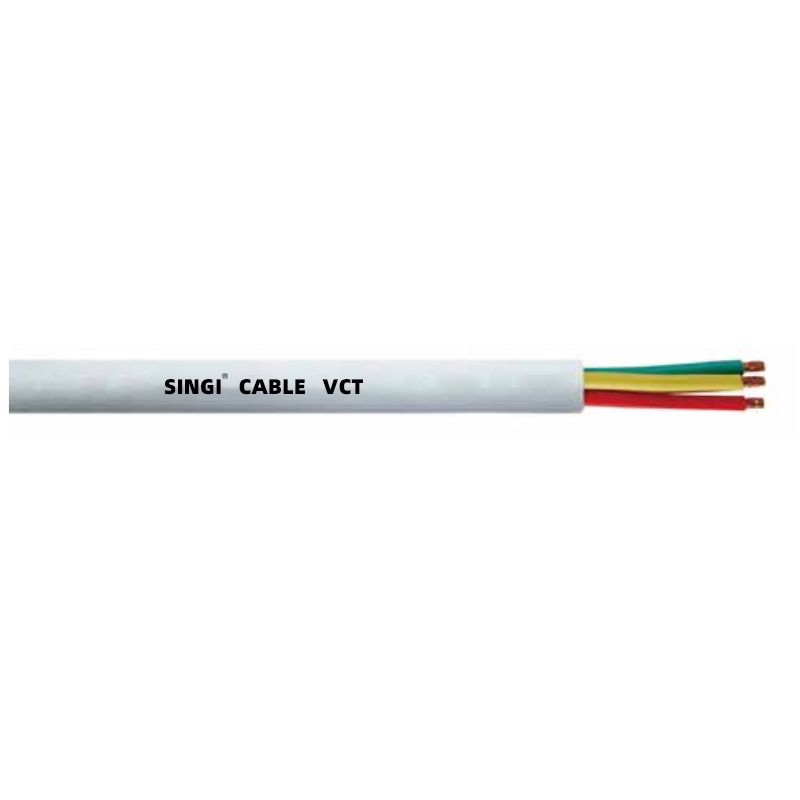
VCT JIS Cable is a PVC insulated and sheathed cable manufactured to Japanese Industrial Standards, supplied by singi-cable. It is engineered for low-volt-level industrial wiring, offering reliable performance in control panels, machinery, and factory installations. This guide helps engineers and procurement specialists understand its construction, standards, choice criteria, and applications.
| Core Count | Nominal Cross-Section (mm²) | Typical Application |
|---|---|---|
| 2-core | 0.75 – 5.5 | Single-phase power supply, small control circuits |
| 3-core | 0.75 – 5.5 | Three-phase motors, equipment grounding |
| 4-core | 0.75 – 5.5 | Three-phase with neutral, advanced control systems |
VCT JIS Cable is a low-volt-level cable designed according to Japanese Industrial Standards, JIS C 3306 for PVC insulated wires and JIS C 3312 for PVC insulated and sheathed cables. The abbreviation VCT stands for Vinyl (PVC), Cable, and Twin (or T for tough rubber? VCT is PVC insulated and PVC sheathed cable). The cable consists of annealed copper conductors, PVC insulation, and a PVC outer sheath, providing good electrical performance and mechanical protection in dry or damp environments.
Compared to standard IV wires, VCT cables include an extra PVC sheath layer, making them more resistant to abrasion, moisture, and minor impacts. This makes VCT JIS Cable suitable for wiring inside machines, distribution boards, and field equipment where flexible yet durable cabling is required.
Industrial environments demand cables that balance flexibility, durability, and safety. VCT JIS Cable meets these requirements through:
For engineers who need a dependable cable for control panels and production equipment, VCT JIS Cable from singi-cable offers a verified solution backed by strict quality control.
Choice involves matching the cable's electrical and physical characteristics to the application. Key considerations include:
VCT JIS Cable is rated for 600V AC. Confirm that this meets the circuit volt-level; for higher volt-levels, other cable types such as CV or CVV may be necessary.
Choose the cross-section based on current-carrying capacity and volt-level drop. The table below provides typical amperage ratings for common sizes (reference JIS C 3312).
| Conductor Size (mm²) | Amperage Capacity (A) | Application Example |
|---|---|---|
| 0.75 | 7 | Signal lines, small relays |
| 1.25 | 12 | Control circuits, solenoid valves |
| 2.0 | 17 | Small motors, power supplies |
| 3.5 | 28 | Three-phase motors up to 2.2 kW |
| 5.5 | 40 | Heavy machinery, power distribution |
Choose the core count based on the circuit. Two-core cables carry single-phase AC; three-core adds an earth conductor; four-core supports three-phase with neutral or mixed signals.
VCT cable is suitable for dry and damp locations, but not for direct burial or outdoor exposure without additional conduit. For harsher environments, consult singi-cable for professional jackets such as chloroprene rubber.
Note: Always verify the cable's ampacity with the applicable JIS tables and account for derating factors when installed in bundles or high-temperature areas.
VCT JIS Cable is widely used in Japanese-export equipment and domestic industrial installations. Typical applications include:
Because VCT JIS Cable conforms to Japanese standards, it is the preferred choice for OEMs that export machinery to Japan. The cable's color-coded cores simplify installation and troubleshooting, reducing assembly errors.
VCT stands for Vinyl (PVC) Cable and Twin (or vinyl-sheathed cable). It is a round or flat cable with PVC insulation and a PVC outer sheath.
No. VCTF is a flexible version with finer stranded conductors, while standard VCT uses ordinary stranded conductors. Both follow JIS C 3312, but VCTF offers greater flexibility for moving applications.
Yes, VCT cable can be pulled through conduit. Its smooth PVC sheath reduces friction, and the outer layer provides additional protection against abrasion during installation.
Yes, singi-cable offers VCT JIS Cable with PSE certification, ensuring compliance with the Japanese Electrical Appliance and Material Safety Law.
Standard VCT cable has a maximum-val conductor temperature of 70°C. For higher temperature environments, consider heat-resistant variants such as VCT-H.
For detailed specifications and pricing, visit the VCT JIS Cable product page at singi-cable. The team can provide technical documentation, sample support, and custom lengths to meet project requirements.
![Singi Cable[Email: singi100@singi.com]](/u_file/2303/photo/11c1fa1eb8.jpg)

