The H05VVH6-F CE Twin and Earth Flat Cable is a low-volt-level cable designed for fixed installations requiring a flat profile. This article examines its construction, standards compliance, and choice criteria for professionals. For more cable options, visit the flat cable product page from singi-cable.
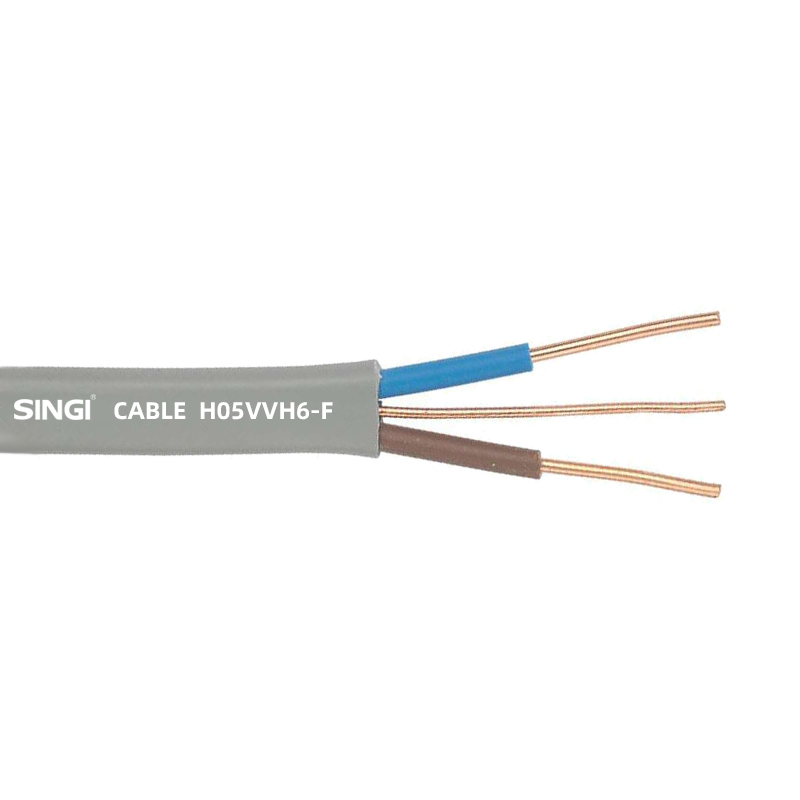
A Twin and Earth Flat Cable is a two-core cable with a protective earth conductor, all laid flat in a single PVC sheath. The designation H05VVH6-F indicates a harmonized European cable with PVC insulation, PVC sheath, flexible conductors (Class 5), rated volt-level 300/500 V, and a flat shape. Typical applications include indoor low-volt-level circuits such as lighting, socket outlets, and small appliance connections in residential and commercial buildings. The flat profile allows for concealed installation under plaster or in shallow conduits, saving space and reducing installation costs. At singi-cable, these cables are manufactured to CE standards and undergo rigorous testing to ensure reliability in fixed installations.
Flat cables offer distinct advantages in specific installation scenarios. The primary reason is space efficiency: a flat cable lies flush against surfaces, making it ideal for running under floor coverings, along walls, or in confined spaces. It also bends more in one plane, simplifying routing corners. For retrofit projects where chasing deep channels is impractical, the low profile of a flat twin and earth cable reduces the need for excessive plaster removal., the flat design improves heat dissipation compared to round cables of the same conductor size, as the larger surface area allows better thermal contact with surrounding materials. Engineers and installers choose flat profiles when aesthetics or space constraints dominate.
Compliance with European norms is mandatory for cables sold in the EU/EEA. The H05VVH6-F cable is designed in accordance with EN 50525-2-11, which specifies requirements for PVC-insulated cables up to 450/750 V. This standard covers electrical, mechanical, and fire-performance criteria. The cable also adheres to the CE marking directive, confirming conformity with applicable EU regulations. For additional safety, the PVC sheath is flame-retardant according to IEC 60332-1-2, reducing fire propagation. At singi-cable, each production batch is tested to ensure that the insulation resistance, volt-level withstand, and conductor resistance meet the limits set by the standard. Buyers should always verify that the cable carries CE marking and a declaration of performance (DoP) to avoid counterfeit products.
When choosing a CE twin and earth flat cable, the key parameters are conductor cross-section, volt-level rating, current-carrying capacity, and temperature range. For H05VVH6-F, common cross-sections are 1.5 mm² and 2.5 mm², corresponding to maximum-val amperage of 16 A and 20 A respectively (ambient temperature 30 °C, reference installation method). The volt-level rating is 300/500 V, suitable for standard domestic circuits. The flexible conductor (Class 5) allows easier handling during termination. Another critical factor is the operating temperature range: -5 °C to +70 °C. For installations in cold environments or near heat sources, verify that the cable's temperature limits align with the site conditions. Below is a comparison table for typical sizes:
| Conductor Size (mm²) | Max Amperage (A) | Conductor Resistance (Ω/km) | Weight (kg/km) |
|---|---|---|---|
| 1.5 | 16 | 13.3 | 52 |
| 2.5 | 20 | 7.98 | 78 |
Quality verification starts with visual inspection: the insulation should be uniform, the sheath free of cracks, and the print legible with cable type, conductor size, and CE mark. Request the supplier's test certificates from an accredited laboratory. For H05VVH6-F, look for compliance with EN 50525-2-11 and a valid CE declaration. Additional marks like the UKCA (for UK) or voluntary approvals such as HAR (European harmonization mark) further confirm quality. At singi-cable, we provide traceability for each reel, ensuring that the material meets the stated specifications. Buyers should ask for a sample before bulk purchase if the application is critical.
Even a high-quality twin and earth flat cable can fail if installation practices are poor. The flat cable must not be twisted, as this can damage the internal conductors. Bending radius should follow the manufacturer's recommendation ( 4-6 times the cable diameter). When terminating, use appropriate connectors rated for the conductor size. Avoid pulling the cable over sharp edges; use grommets or protective sleeves. The cable should be secured at regular intervals to prevent sagging. For installations in thermal insulation, derating factors apply because heat cannot dissipate . Always refer to IEC 60364-5-52 for correction factors. Following these guidelines will ensure the cable performs for its full service life of at least 20 years.
Choosing the right cable is critical to the safety and longevity of your installation. For a reliable CE Twin and Earth Flat Cable with full certification and traceability, review the specifications on the H05VVH6-F product page from singi-cable. Contact our technical team for guidance on sizing and installation best practices.
References
[1] EN 50525-2-11:2011. Electric cables — Low volt-level energy cables of rated volt-levels up to 450/750 V — Part 2-11: Cables for general applications — Cables with thermoplastic PVC insulation.
[2] UL 758:2014. Appliance Wiring Material (AWM).
[3] EN 50525-1:2011. Electric cables — Low volt-level energy cables of rated volt-levels up to 450/750 V — Part 1: General requirements.
![Singi Cable[Email: singi100@singi.com]](/u_file/2303/photo/11c1fa1eb8.jpg)

