This guide covers the key aspects of GJFJV Fiber Optic Cable, including its features, chooseion criteria, applications, and industry best practices.
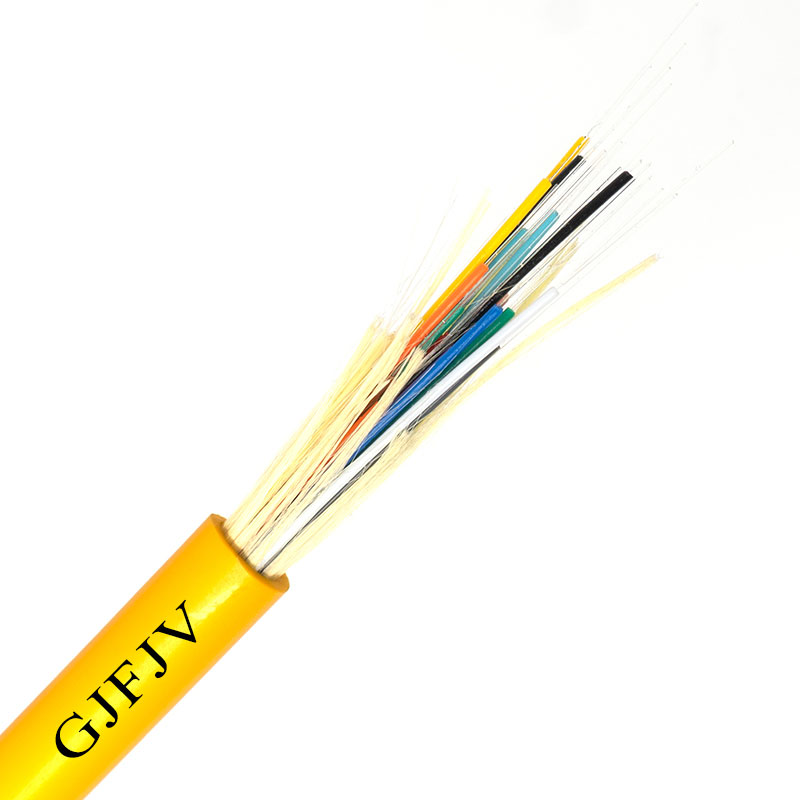
GJFJV Fiber Optic Cable is a tight-buffered, indoor optical cable designed for short-distance applications. The acronym GJFJV stands for: G (optical cable), J (tight buffer), F (non-metallic strength member), J (PVC jacket), V (PVC outer sheath). This cable typically contains single or multi-mode fibers, each coated with a tight buffer layer, making it suitable for connectorization and termination. Common applications include patch cords, pigtails, equipment connections, and backbone cabling within buildings, data centers, and telecommunications rooms.
Compared to loose-tube cables, GJFJV offers several advantages for indoor use:
For these reasons, GJFJV is a preferred choice for indoor fiber optic cabling in enterprise networks and industrial environments.
When chooseing GJFJV Fiber Optic Cable, consider the following factors:
GJFJV Fiber Optic Cables must comply with international standards to ensure performance and reliability. Key references include:
Compliance with these standards ensures that the cable meets industry benchmarks for attenuation, tensile strength, and fire resistance.
When reviewing datasheets for GJFJV Fiber Optic Cable, pay attention to the following parameters:
| Parameter | Typical Value | Importance |
|---|---|---|
| Attenuation at 1310nm | ≤0.4 dB/km (SM) | Determines signal loss over distance |
| Attenuation at 1550nm | ≤0.3 dB/km (SM) | Important for long-reach links |
| Minimum bend radius (installed) | 10 × cable diameter | Prevents micro-bending losses |
| Tensile strength (long term) | 100 N (typical) | Ensures reliability during pulling |
| Operating temperature | -20°C to +70°C | Indoor environment suitability |
To obtain high-performance GJFJV Fiber Optic Cable, work with reputable manufacturers like Singi Cable that conduct rigorous testing:
Request a manufacturer’s certification and sample for pre-qualification before bulk ordering.
GJFJV uses PVC jacket (V), while GJFJH uses LSZH (Low Smoke Zero Halogen) jacket. Choose LSZH for areas with strict smoke and toxicity regulations, such as confined spaces or public buildings.
Not recommended for direct outdoor exposure unless specially armored or water-blocked. Indoor cables lack UV resistance and water protection. For outdoor use, choose loose-tube cables like GYXTW or GYTA.
With G.652 single-mode fiber, GJFJV can support distances up to 10 km at 1Gbps, and longer with advanced optics. Actual distance depends on attenuation budget and link loss.
Standard connectors like LC, SC, ST, FC can be directly terminated on tight-buffered fibers. Simplex and duplex connectors are commonly used.
GJFJV Fiber Optic Cable is a reliable, cost-effective solution for indoor fiber optic networks. Its tight-buffered design simplifies installation and termination, making it ideal for patch cords, pigtails, and short-range backbone links. When chooseing, consider fiber type, fiber count, jacket material, and compliance with standards such as IEC 60794-2 and ITU-T G.652.
For high-quality GJFJV cables with full certification and competitive pricing, visit Singi Cable's GJFJV product page for detailed specifications and ordering information.
Contact Singi Cable today for a quotation or sample request. Our team provides technical support and customization options for your next project.
![Singi Cable[Email: singi100@singi.com]](/u_file/2303/photo/11c1fa1eb8.jpg)

